
Every county medical examiner’s office and morgue facility operates under two simultaneous inventory realities: the day-to-day case volume that drives standard procurement, and the surge scenario that no budget line ever quite prepares for. Tornadoes, flooding, mass casualty incidents, pandemic-level mortality spikes – when they hit, the facilities that respond effectively are the ones that calculated their emergency reserve numbers before the event, not during it.
The calculation is not complicated. But it requires a structured methodology, a clear understanding of the difference between standard and heavy-duty pouch requirements, and – critically – the budget justification language that gets a reserve inventory line approved by a county administrator or board of supervisors who has never managed a mass casualty response.
This guide gives medical examiners and morgue managers the step-by-step framework to calculate their county-level emergency reserve numbers, build the standard vs. heavy-duty split, and translate that number into a budget justification that holds up in a procurement meeting.
Why County-Level Emergency Reserve Calculations Are a Medical Examiner’s Responsibility
FEMA’s Comprehensive Preparedness Guide (CPG 101) and the National Incident Management System (NIMS) both establish that mass fatality planning is a core emergency management function. For county medical examiners, that planning obligation extends directly to supply reserve calculations. The question is not whether your county needs an emergency reserve of body pouches. The question is whether you have calculated the right number – and whether your budget reflects it.
What Happens When Reserve Numbers Are Wrong
- Undersupply during surge: facilities that run out of standard pouches during a mass casualty event improvise – creating dignity, containment, and chain of custody failures that cannot be corrected after the fact
- No heavy-duty allocation: counties without a calculated heavy-duty pouch reserve discover the gap during a bariatric surge, when procurement lead times are longest and supplier surge capacity is most strained
- Reactive procurement at peak prices: emergency purchasing during an active incident typically costs 20 to 40 percent more than pre-planned procurement – a cost difference that comes directly out of your operating budget
- Audit exposure: medical examiner offices subject to state audit or accreditation review are increasingly expected to demonstrate documented mass fatality supply planning – an undocumented reserve calculation is a compliance gap
The Three Planning Documents That Anchor Your Calculation
- Your county’s Mass Fatality Incident (MFI) plan – the source of your jurisdiction’s worst-case scenario population estimates
- Your office’s 24-month case history – the baseline for understanding your standard and bariatric case rate
- Your mutual aid agreements – the commitments that may draw on your reserve inventory when neighboring jurisdictions are simultaneously impacted
Step-by-Step: Calculating Your Standard Pouch Emergency Reserve
Standard body pouches cover the majority of cases in any mass fatality scenario. Your reserve calculation for this category starts with your jurisdiction’s baseline mortality data and scales to your worst-case planning scenario.
Step 1. Establish Your Baseline Daily Case Rate
Pull your office’s case intake records for the past 24 months. Calculate your average daily case volume and identify your highest single-day intake on record. These two numbers bracket the range your reserve must cover.
| 📊 BASELINE DAILY RATE FORMULAFormula: Total cases (24 months) ÷ 730 days = Average daily case rateExample: County processed 1,460 cases over 24 months: 1,460 ÷ 730 = 2.0 average daily cases |
Step 2. Identify Your Surge Multiplier From Your MFI Plan
Your county’s Mass Fatality Incident plan should specify a surge planning scenario — typically expressed as a multiple of your baseline daily case rate or as an absolute casualty figure tied to a specific hazard scenario (tornado corridor, flood plain, industrial facility proximity). If your MFI plan does not specify a surge figure, FEMA guidance recommends planning for a minimum 72-hour surge at 10 times baseline daily volume for mid-sized counties.
| 📊 72-HOUR SURGE VOLUME FORMULAFormula: Average daily case rate × Surge multiplier × 72 hours = Minimum surge volumeExample: 2.0 daily cases × 10x surge × 3 days = 60 cases minimum surge volume |
Step 3. Apply Your Reserve Buffer Multiplier
The surge volume calculation gives you the minimum. Your emergency reserve should exceed the minimum by a buffer that accounts for mutual aid draws, extended incident timelines, and the reality that supply replenishment during an active mass casualty event cannot be guaranteed within 72 hours regardless of supplier relationship.
| 📊 STANDARD POUCH RESERVE FORMULAFormula: Surge volume × 1.5 buffer = Standard pouch emergency reserveExample: 60 surge cases × 1.5 = 90 standard pouches minimum emergency reserve |
Step-by-Step: Calculating Your Heavy-Duty Pouch Emergency Reserve
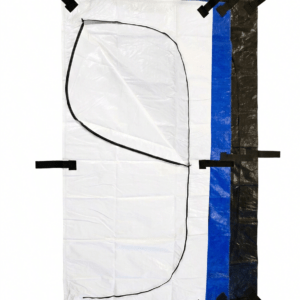
Heavy-duty pouches — reinforced construction, higher weight capacity, 8-handle systems for bariatric cases — represent a distinct inventory category that requires its own reserve calculation. The mistake most offices make is applying a flat percentage of their standard reserve without grounding the number in actual bariatric case data.
Step 1. Establish Your Bariatric Case Rate
Pull your 24-month case history and identify every case requiring a heavy-duty or oversized pouch. Calculate the percentage of total caseload that required heavy-duty containment. CDC data on adult obesity prevalence suggests a national average in the range of 15 to 20 percent of adult decedent cases — but your local rate may be higher or lower depending on your jurisdiction’s demographics.
| 📊 BARIATRIC CASE RATE FORMULAFormula: Heavy-duty cases (24 months) ÷ Total cases (24 months) × 100 = Bariatric case rate %Example: 218 heavy-duty cases ÷ 1,460 total cases × 100 = 14.9% bariatric case rate |
Step 2. Apply Your Bariatric Rate to Surge Volume
Apply your office’s actual bariatric case rate to your surge volume figure to calculate the expected heavy-duty pouch demand during a mass casualty event. Do not use a generic industry figure if your local data shows a higher rate — your reserve calculation should reflect your jurisdiction, not a national average.
| 📊 HEAVY-DUTY SURGE DEMAND FORMULAFormula: Surge volume × Bariatric case rate % = Heavy-duty surge demandExample: 60 surge cases × 14.9% = 9 heavy-duty pouches minimum surge demand |
Step 3. Apply an Elevated Buffer for Heavy-Duty Products
Heavy-duty pouches warrant a higher buffer multiplier than standard pouches for two reasons: supplier lead times for specialty products are longer during surge periods, and the operational consequence of running out of heavy-duty containment — staff injury risk, improvised handling, dignity failures — is more severe than a standard pouch shortfall.
| 📊 HEAVY-DUTY POUCH RESERVE FORMULAFormula: Heavy-duty surge demand × 2.0 buffer = Heavy-duty pouch emergency reserveExample: 9 heavy-duty surge demand × 2.0 = 18 heavy-duty pouches minimum emergency reserve |
Building the Full Reserve Inventory Picture: Combined Calculation Summary
Once standard and heavy-duty reserves are calculated independently, combine them into a single reserve inventory figure that captures total emergency pouch requirements for your jurisdiction.
| 📊 TOTAL EMERGENCY RESERVE FORMULAFormula: Standard pouch reserve + Heavy-duty pouch reserve = Total emergency pouch reserveExample: 90 standard + 18 heavy-duty = 108 total emergency reserve pouches |
Adjustments for Mutual Aid Obligations
If your county operates under mutual aid agreements that commit your office to supporting neighboring jurisdictions during a declared emergency, your reserve calculation must account for that draw. Review your mutual aid commitments and add a supplemental allocation based on the population ratio of the jurisdictions you are obligated to support.
- Identify each jurisdiction covered under your mutual aid agreement
- Calculate the population ratio between your county and each covered jurisdiction
- Add a proportional allocation to your total reserve figure for each mutual aid commitment
- Document mutual aid adjustments separately in your procurement justification so the rationale is auditable
Establishing a Reorder Trigger Point
An emergency reserve is only effective if it is maintained. Define a reorder trigger – the inventory level at which procurement is initiated – that gives your office enough lead time to replenish before the reserve is depleted. A 30-day procurement lead time assumption is conservative for a domestic supplier relationship; adjust based on your actual supplier terms.
| 📊 REORDER TRIGGER FORMULAFormula: Total reserve ÷ Average daily case rate × Procurement lead time (days) = Reorder trigger pointExample: 108 pouches ÷ 2.0 daily cases × 30 day lead time = Reorder at 60 pouches remaining |
Translating Your Reserve Calculation Into a Budget Justification
The calculation gets you to the right number. The budget justification gets that number approved. Medical examiners and morgue managers presenting emergency reserve procurement requests to county administrators, finance committees, or boards of supervisors need to frame the request in language that resonates with decision-makers who manage risk across an entire county budget – not just the medical examiner’s office.
The Four Budget Justification Arguments That Work
- Cost of reactive procurement vs. planned procurement: emergency purchasing during an active mass casualty incident typically carries a 20 to 40 percent price premium over pre-planned procurement. On a 108-unit reserve at average unit cost, that premium represents real dollars that disappear from your operating budget when reserve procurement is deferred. Present this as a cost avoidance argument – not a spending request.
- Operational continuity and liability exposure: a county medical examiner’s office that cannot maintain chain of custody and dignified containment during a mass casualty event due to supply failure is exposed to legal liability, state audit findings, and reputational consequences that cost far more than the reserve inventory. Frame the procurement as institutional risk management, not supply spending.
- FEMA and NIMS compliance alignment: CPG 101 and NIMS both require documented mass fatality supply planning at the county level. A calculated and procured emergency reserve is the physical evidence of that compliance. An undocumented or unfunded reserve is a gap that FEMA preparedness assessments and state emergency management audits will identify. Budget approval closes a documented compliance gap.
- Annualized cost framing: emergency reserve inventory does not expire in a single budget cycle. Amortize the reserve procurement cost across a 3-year service life assumption to present the annual cost impact – a figure that is typically modest in the context of a county budget but significant in the context of a mass fatality response.
| 📊 ANNUALIZED RESERVE COST FORMULAFormula: Total reserve units × Unit cost ÷ 3-year service life = Annual budget impactExample: 108 units × $12 avg. unit cost ÷ 3 years = $432 annual budget impact |
What to Include in a Written Budget Justification
- Your jurisdiction’s Mass Fatality Incident plan reference and the surge scenario it defines
- Your 24-month case history data showing baseline and peak daily case volume
- The standard and heavy-duty reserve calculations with formulas and inputs documented
- Mutual aid agreement obligations and the reserve allocation they require
- Cost comparison between pre-planned procurement and estimated reactive procurement pricing
- FEMA CPG 101 and NIMS compliance language citing the documented planning obligation
- Annualized cost figure and 3-year amortization schedule
- Supplier documentation confirming domestic manufacturing, product specifications, and lead time terms
Frequently Asked Questions
Q1: Is there a FEMA-specified minimum emergency reserve standard for body pouches at the county level?
FEMA’s Comprehensive Preparedness Guide (CPG 101) and NIMS establish mass fatality planning as a required county-level emergency management function but do not prescribe specific minimum reserve quantities for body pouches. The planning obligation is clear; the quantity calculation is left to individual jurisdictions based on local hazard scenarios, population size, and historical case data. This is why a documented, data-driven calculation methodology — rather than a generic estimate – is the defensible basis for your reserve procurement request. Some states have developed supplemental guidance with suggested reserve ratios; check with your state emergency management agency for jurisdiction-specific standards.
Q2: How often should a county medical examiner’s office recalculate its emergency reserve numbers?
Reserve calculations should be reviewed annually at minimum, and following any mass fatality event that drew on reserve inventory. Three specific triggers warrant an immediate recalculation: a significant change in your county’s population or demographic profile that affects bariatric case rate projections; an update to your county’s Mass Fatality Incident plan that revises surge scenario assumptions; or a change in mutual aid agreements that expands or contracts your office’s surge support obligations. Reserve numbers calculated more than three years ago without revision should be treated as outdated regardless of whether any of these triggers have occurred.
Q3: What is the correct way to store emergency reserve body pouches to maintain their integrity over a multi-year reserve period?
Emergency reserve body pouches should be stored in a cool, dry environment maintained between 50°F and 75°F, away from direct sunlight, UV exposure, chemical storage, and heat sources. High-gauge polyethylene products that meet institutional specifications typically maintain material integrity for 3 to 5 years under proper storage conditions. Reserve inventory should be physically inspected annually as part of your reserve recalculation review — checking for material brittleness, zipper function, seam integrity, and label legibility. Rotate reserve inventory into active use before the end of the recommended service life and replenish to calculated reserve levels as part of your standard procurement cycle.
Q4: Should standard and heavy-duty pouches be stored separately in an emergency reserve?
Yes – and the separation should be clearly labeled and documented in your supply management records. Commingled standard and heavy-duty inventory creates sorting delays during the high-pressure intake conditions of a mass casualty event. Dedicated, clearly labeled reserve sections for each product category – with quantity counts posted at the storage location — allow staff to confirm reserve status without counting and handling inventory during an active incident. Your emergency reserve storage protocol should be included in your Mass Fatality Incident plan as a documented procedure, not left to informal practice.
Q5: Can Classic Plastics Corp support county medical examiner offices with procurement documentation for budget justification purposes?
Yes. Classic Plastics Corp provides institutional customers with written product specifications, material certifications, unit pricing documentation, and lead time confirmation suitable for inclusion in county procurement and budget justification packages. We work directly with medical examiner offices, county emergency management agencies, and government procurement offices to support the documentation requirements of formal budget approval processes. Contact our institutional sales team to request a procurement support package tailored to your county’s budget justification requirements.
Summary
County-level emergency reserve calculations for body pouches are a documented planning obligation — and a budget justification opportunity for medical examiners who know how to frame them. The methodology is straightforward when applied systematically: baseline case data, surge multiplier from your MFI plan, product-specific buffer ratios, and mutual aid adjustments combine to produce a defensible, auditable reserve number that administrators can approve with confidence.
- Standard pouch reserves are calculated from baseline daily case rate, surge multiplier, and a 1.5x buffer — covering the majority of mass casualty case volume
- Heavy-duty pouch reserves require a separate calculation based on your actual bariatric case rate applied to surge volume, with a 2.0x buffer that reflects longer lead times and higher operational consequence of supply failure
- Mutual aid obligations and reorder trigger points complete the reserve picture — ensuring the number you calculate is also the number you maintain
- Budget justification frames reserve procurement as cost avoidance, institutional risk management, FEMA compliance, and annualized investment – not a supply spending request
- Written documentation of calculation methodology, product specifications, and supplier terms is the difference between a reserve request that gets approved and one that gets deferred
The best time to calculate your county’s emergency reserve numbers was before the last mass fatality event. The second best time is now.